TcpSocket Class Reference
[Basic sockets]
Socket implementation for TCP.
More...
#include <TcpSocket.h>
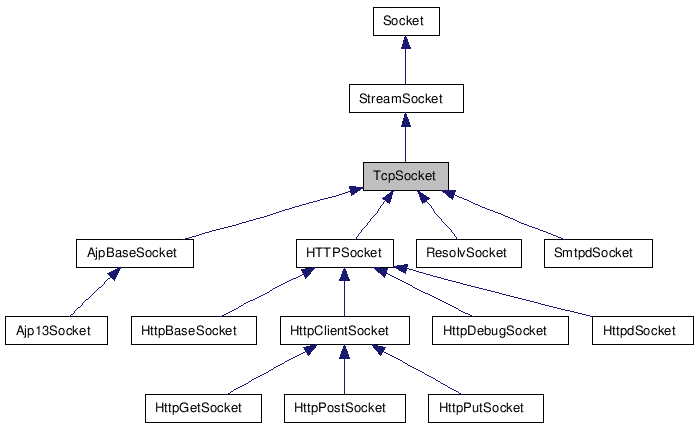
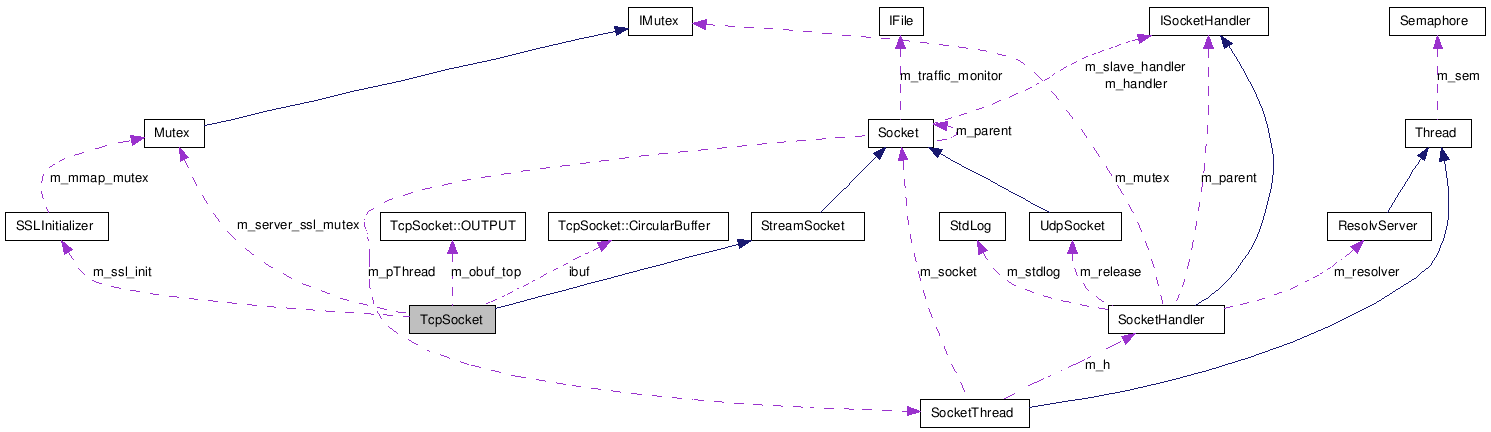
Public Member Functions | |
| TcpSocket (ISocketHandler &) | |
| Constructor with standard values on input/output buffers. | |
| TcpSocket (ISocketHandler &h, size_t isize, size_t osize) | |
| Constructor with custom values for i/o buffer. | |
| ~TcpSocket () | |
| bool | Open (ipaddr_t ip, port_t port, bool skip_socks=false) |
| Open a connection to a remote server. | |
| bool | Open (SocketAddress &, bool skip_socks=false) |
| bool | Open (SocketAddress &, SocketAddress &bind_address, bool skip_socks=false) |
| bool | Open (const std::string &host, port_t port) |
| Open connection. | |
| void | OnConnectTimeout () |
| Connect timeout callback. | |
| int | Close () |
| Close file descriptor - internal use only. | |
| void | Send (const std::string &s, int f=0) |
| Send a string. | |
| void | Sendf (const char *format,...) |
| Send string using printf formatting. | |
| void | SendBuf (const char *buf, size_t len, int f=0) |
| Send buffer of bytes. | |
| virtual void | OnRawData (const char *buf, size_t len) |
| This callback is executed after a successful read from the socket. | |
| virtual void | OnWriteComplete () |
| Called when output buffer has been sent. | |
| size_t | GetInputLength () |
| Number of bytes in input buffer. | |
| size_t | ReadInput (char *buf, size_t sz) |
| Read from input buffer. | |
| size_t | GetOutputLength () |
| Number of bytes in output buffer. | |
| void | OnLine (const std::string &line) |
| Callback fires when a socket in line protocol has read one full line. | |
| uint64_t | GetBytesReceived (bool clear=false) |
| Get counter of number of bytes received. | |
| uint64_t | GetBytesSent (bool clear=false) |
| Get counter of number of bytes sent. | |
| void | OnSocks4Connect () |
| Socks4 specific callback. | |
| void | OnSocks4ConnectFailed () |
| Socks4 specific callback. | |
| bool | OnSocks4Read () |
| Socks4 specific callback. | |
| void | OnResolved (int id, ipaddr_t a, port_t port) |
| Callback executed when resolver thread has finished a resolve request. | |
| void | OnSSLConnect () |
| Callback for 'New' ssl support - replaces SSLSocket. | |
| void | OnSSLAccept () |
| Callback for 'New' ssl support - replaces SSLSocket. | |
| virtual void | InitSSLClient () |
| This method must be implemented to initialize the ssl context for an outgoing connection. | |
| virtual void | InitSSLServer () |
| This method must be implemented to initialize the ssl context for an incoming connection. | |
| void | SetReconnect (bool=true) |
| Flag that says a broken connection will try to reconnect. | |
| bool | Reconnect () |
| Check reconnect on lost connection flag status. | |
| void | SetIsReconnect (bool x=true) |
| Flag to determine if a reconnect is in progress. | |
| bool | IsReconnect () |
| Socket is reconnecting. | |
| void | DisableInputBuffer (bool=true) |
| Use this if you only use OnRawData to process received data. | |
| void | OnOptions (int, int, int, SOCKET) |
| Called when a client socket is created, to set socket options. | |
| void | SetLineProtocol (bool=true) |
| Called after OnRead if socket is in line protocol mode. | |
| const std::string | GetLine () const |
| Get the unfinished line when using SetLineProtocol = true. | |
| bool | SetTcpNodelay (bool=true) |
| virtual int | Protocol () |
| Returns IPPROTO_TCP or IPPROTO_SCTP. | |
| void | SetTransferLimit (size_t sz) |
| Trigger limit for callback OnTransferLimit. | |
| virtual void | OnTransferLimit () |
| This callback fires when the output buffer drops below the value set by SetTransferLimit. | |
Protected Types | |
| typedef std::list< OUTPUT * > | output_l |
Protected Member Functions | |
| TcpSocket (const TcpSocket &) | |
| void | OnRead () |
| Called when there is something to be read from the file descriptor. | |
| void | OnRead (char *buf, size_t n) |
| void | OnWrite () |
| Called when there is room for another write on the file descriptor. | |
| void | InitializeContext (const std::string &context, const SSL_METHOD *meth_in=NULL) |
| SSL; Initialize ssl context for a client socket. | |
| void | InitializeContext (const std::string &context, const std::string &keyfile, const std::string &password, const SSL_METHOD *meth_in=NULL) |
| SSL; Initialize ssl context for a server socket. | |
| void | InitializeContext (const std::string &context, const std::string &certfile, const std::string &keyfile, const std::string &password, const SSL_METHOD *meth_in=NULL) |
| SSL; Initialize ssl context for a server socket. | |
| void | UseCertificateChainFile (const std::string &filename) |
| SSL; load certificate chain from file. | |
| virtual SSL_CTX * | GetSslContext () |
| SSL; Get pointer to ssl context structure. | |
| virtual SSL * | GetSsl () |
| SSL; Get pointer to ssl structure. | |
| bool | SSLNegotiate () |
| ssl; still negotiating connection. | |
| const std::string & | GetPassword () |
| SSL; Get ssl password. | |
Static Protected Member Functions | |
| static int | SSL_password_cb (char *buf, int num, int rwflag, void *userdata) |
| SSL; Password callback method. | |
Protected Attributes | |
| CircularBuffer | ibuf |
| Circular input buffer. | |
Private Member Functions | |
| TcpSocket & | operator= (const TcpSocket &) |
| void | SendFromOutputBuffer () |
| int | TryWrite (const char *buf, size_t len) |
| the actual send() | |
| void | Buffer (const char *buf, size_t len) |
| add data to output buffer top | |
Private Attributes | |
| bool | m_b_input_buffer_disabled |
| uint64_t | m_bytes_sent |
| uint64_t | m_bytes_received |
| bool | m_skip_c |
| Skip second char of CRLF or LFCR sequence in OnRead. | |
| char | m_c |
| First char in CRLF or LFCR sequence. | |
| std::vector< char > | m_line |
| Current line in line protocol mode. | |
| size_t | m_line_ptr |
| char * | m_buf |
| temporary read buffer | |
| output_l | m_obuf |
| output buffer | |
| OUTPUT * | m_obuf_top |
| output buffer on top | |
| size_t | m_transfer_limit |
| size_t | m_output_length |
| size_t | m_repeat_length |
| SSL_CTX * | m_ssl_ctx |
| ssl context | |
| SSL * | m_ssl |
| ssl 'socket' | |
| BIO * | m_sbio |
| ssl bio | |
| std::string | m_password |
| ssl password | |
| int | m_socks4_state |
| socks4 support | |
| char | m_socks4_vn |
| socks4 support, temporary variable | |
| char | m_socks4_cd |
| socks4 support, temporary variable | |
| unsigned short | m_socks4_dstport |
| socks4 support | |
| unsigned long | m_socks4_dstip |
| socks4 support | |
| int | m_resolver_id |
| Resolver id (if any) for current Open call. | |
| bool | m_b_reconnect |
| Reconnect on lost connection flag. | |
| bool | m_b_is_reconnect |
| Trying to reconnect. | |
Static Private Attributes | |
| static SSLInitializer | m_ssl_init |
| static Mutex | m_server_ssl_mutex |
| static std::map< std::string, SSL_CTX * > | m_client_contexts |
| static std::map< std::string, SSL_CTX * > | m_server_contexts |
Classes | |
| class | CircularBuffer |
| Buffer class containing one read/write circular buffer. More... | |
| struct | OUTPUT |
| Output buffer struct. More... | |
Detailed Description
Socket implementation for TCP.Definition at line 62 of file TcpSocket.h.
Member Typedef Documentation
typedef std::list<OUTPUT *> TcpSocket::output_l [protected] |
Definition at line 121 of file TcpSocket.h.
Constructor & Destructor Documentation
| TcpSocket::TcpSocket | ( | ISocketHandler & | h | ) |
Constructor with standard values on input/output buffers.
Definition at line 86 of file TcpSocket.cpp.
00086                                       : StreamSocket(h)
00087 ,ibuf(TCP_BUFSIZE_READ)
00088 ,m_b_input_buffer_disabled(false)
00089 ,m_bytes_sent(0)
00090 ,m_bytes_received(0)
00091 ,m_skip_c(false)
00092 ,m_line(Handler().MaxTcpLineSize())
00093 ,m_line_ptr(0)
00094 #ifdef SOCKETS_DYNAMIC_TEMP
00095 ,m_buf(new char[TCP_BUFSIZE_READ + 1])
00096 #endif
00097 ,m_obuf_top(NULL)
00098 ,m_transfer_limit(0)
00099 ,m_output_length(0)
00100 ,m_repeat_length(0)
00101 #ifdef HAVE_OPENSSL
00102 ,m_ssl_ctx(NULL)
00103 ,m_ssl(NULL)
00104 ,m_sbio(NULL)
00105 #endif
00106 #ifdef ENABLE_SOCKS4
00107 ,m_socks4_state(0)
00108 #endif
00109 #ifdef ENABLE_RESOLVER
00110 ,m_resolver_id(0)
00111 #endif
00112 #ifdef ENABLE_RECONNECT
00113 ,m_b_reconnect(false)
00114 ,m_b_is_reconnect(false)
00115 #endif
00116 {
00117 }
| TcpSocket::TcpSocket | ( | ISocketHandler & | h, | |
| size_t | isize, | |||
| size_t | osize | |||
| ) |
Constructor with custom values for i/o buffer.
- Parameters:
-
h ISocketHandler reference isize Input buffer size osize Output buffer size
Definition at line 126 of file TcpSocket.cpp.
00126                                                                 : StreamSocket(h)
00127 ,ibuf(isize)
00128 ,m_b_input_buffer_disabled(false)
00129 ,m_bytes_sent(0)
00130 ,m_bytes_received(0)
00131 ,m_skip_c(false)
00132 ,m_line(Handler().MaxTcpLineSize())
00133 ,m_line_ptr(0)
00134 #ifdef SOCKETS_DYNAMIC_TEMP
00135 ,m_buf(new char[TCP_BUFSIZE_READ + 1])
00136 #endif
00137 ,m_obuf_top(NULL)
00138 ,m_transfer_limit(0)
00139 ,m_output_length(0)
00140 ,m_repeat_length(0)
00141 #ifdef HAVE_OPENSSL
00142 ,m_ssl_ctx(NULL)
00143 ,m_ssl(NULL)
00144 ,m_sbio(NULL)
00145 #endif
00146 #ifdef ENABLE_SOCKS4
00147 ,m_socks4_state(0)
00148 #endif
00149 #ifdef ENABLE_RESOLVER
00150 ,m_resolver_id(0)
00151 #endif
00152 #ifdef ENABLE_RECONNECT
00153 ,m_b_reconnect(false)
00154 ,m_b_is_reconnect(false)
00155 #endif
00156 {
00157 }
| TcpSocket::~TcpSocket | ( | ) |
Definition at line 163 of file TcpSocket.cpp.
References m_buf, m_obuf, and m_ssl.
00164 {
00165 #ifdef SOCKETS_DYNAMIC_TEMP
00166         delete[] m_buf;
00167 #endif
00168         // %! empty m_obuf
00169         while (m_obuf.size())
00170         {
00171                 output_l::iterator it = m_obuf.begin();
00172                 OUTPUT *p = *it;
00173                 delete p;
00174                 m_obuf.erase(it);
00175         }
00176 #ifdef HAVE_OPENSSL
00177         if (m_ssl)
00178         {
00179                 SSL_free(m_ssl);
00180         }
00181 #endif
00182 }
| TcpSocket::TcpSocket | ( | const TcpSocket & | s | ) | [protected] |
Member Function Documentation
Open a connection to a remote server.
If you want your socket to connect to a server, always call Open before Add'ing a socket to the sockethandler. If not, the connection attempt will not be monitored by the socket handler...
- Parameters:
-
ip IP address port Port number skip_socks Do not use socks4 even if configured
Definition at line 185 of file TcpSocket.cpp.
Referenced by HttpGetSocket::DoConnect(), OnResolved(), Open(), HttpPutSocket::Open(), and HttpPostSocket::Open().
00186 {
00187         Ipv4Address ad(ip, port);
00188         Ipv4Address local;
00189         return Open(ad, local, skip_socks);
00190 }
| bool TcpSocket::Open | ( | SocketAddress & | ad, | |
| bool | skip_socks = false | |||
| ) |
Definition at line 204 of file TcpSocket.cpp.
References Open().
00205 {
00206         Ipv4Address bind_ad("0.0.0.0", 0);
00207         return Open(ad, bind_ad, skip_socks);
00208 }
| bool TcpSocket::Open | ( | SocketAddress & | ad, | |
| SocketAddress & | bind_address, | |||
| bool | skip_socks = false | |||
| ) |
Definition at line 211 of file TcpSocket.cpp.
References Socket::Attach(), closesocket, Socket::CopyConnection(), Socket::CreateSocket(), Errno, ISocketHandler::FindConnection(), SocketAddress::GetFamily(), SocketAddress::GetPort(), Socket::GetSocks4Host(), Socket::GetSocks4Port(), Socket::Handler(), INVALID_SOCKET, SocketAddress::IsValid(), Utility::l2ip(), Utility::l2string(), LOG_LEVEL_FATAL, LOG_LEVEL_INFO, ISocketHandler::LogError(), Open(), Reconnect(), Socket::SetCallOnConnect(), Socket::SetClientRemoteAddress(), Socket::SetCloseAndDelete(), StreamSocket::SetConnecting(), Socket::SetIsClient(), Socket::SetNonblocking(), Socket::SetRemoteAddress(), Socket::SetSocks4(), Socket::Socks4(), and StrError.
00212 {
00213         if (!ad.IsValid())
00214         {
00215                 Handler().LogError(this, "Open", 0, "Invalid SocketAddress", LOG_LEVEL_FATAL);
00216                 SetCloseAndDelete();
00217                 return false;
00218         }
00219         if (Handler().GetCount() >= Handler().MaxCount())
00220         {
00221                 Handler().LogError(this, "Open", 0, "no space left for more sockets", LOG_LEVEL_FATAL);
00222                 SetCloseAndDelete();
00223                 return false;
00224         }
00225         SetConnecting(false);
00226 #ifdef ENABLE_SOCKS4
00227         SetSocks4(false);
00228 #endif
00229         // check for pooling
00230 #ifdef ENABLE_POOL
00231         if (Handler().PoolEnabled())
00232         {
00233                 ISocketHandler::PoolSocket *pools = Handler().FindConnection(SOCK_STREAM, "tcp", ad);
00234                 if (pools)
00235                 {
00236                         CopyConnection( pools );
00237                         delete pools;
00238
00239                         SetIsClient();
00240                         SetCallOnConnect(); // ISocketHandler must call OnConnect
00241                         Handler().LogError(this, "SetCallOnConnect", 0, "Found pooled connection", LOG_LEVEL_INFO);
00242                         return true;
00243                 }
00244         }
00245 #endif
00246         // if not, create new connection
00247         SOCKET s = CreateSocket(ad.GetFamily(), SOCK_STREAM, "tcp");
00248         if (s == INVALID_SOCKET)
00249         {
00250                 return false;
00251         }
00252         // socket must be nonblocking for async connect
00253         if (!SetNonblocking(true, s))
00254         {
00255                 SetCloseAndDelete();
00256                 closesocket(s);
00257                 return false;
00258         }
00259 #ifdef ENABLE_POOL
00260         SetIsClient(); // client because we connect
00261 #endif
00262         SetClientRemoteAddress(ad);
00263         int n = 0;
00264         if (bind_ad.GetPort() != 0)
00265         {
00266                 bind(s, bind_ad, bind_ad);
00267         }
00268 #ifdef ENABLE_SOCKS4
00269         if (!skip_socks && GetSocks4Host() && GetSocks4Port())
00270         {
00271                 Ipv4Address sa(GetSocks4Host(), GetSocks4Port());
00272                 {
00273                         std::string sockshost;
00274                         Utility::l2ip(GetSocks4Host(), sockshost);
00275                         Handler().LogError(this, "Open", 0, "Connecting to socks4 server @ " + sockshost + ":" +
00276                                 Utility::l2string(GetSocks4Port()), LOG_LEVEL_INFO);
00277                 }
00278                 SetSocks4();
00279                 n = connect(s, sa, sa);
00280                 SetRemoteAddress(sa);
00281         }
00282         else
00283 #endif
00284         {
00285                 n = connect(s, ad, ad);
00286                 SetRemoteAddress(ad);
00287         }
00288         if (n == -1)
00289         {
00290                 // check error code that means a connect is in progress
00291 #ifdef _WIN32
00292                 if (Errno == WSAEWOULDBLOCK)
00293 #else
00294                 if (Errno == EINPROGRESS)
00295 #endif
00296                 {
00297                         Attach(s);
00298                         SetConnecting( true ); // this flag will control fd_set's
00299                 }
00300                 else
00301 #ifdef ENABLE_SOCKS4
00302                 if (Socks4() && Handler().Socks4TryDirect() ) // retry
00303                 {
00304                         closesocket(s);
00305                         return Open(ad, true);
00306                 }
00307                 else
00308 #endif
00309 #ifdef ENABLE_RECONNECT
00310                 if (Reconnect())
00311                 {
00312                         Handler().LogError(this, "connect: failed, reconnect pending", Errno, StrError(Errno), LOG_LEVEL_INFO);
00313                         Attach(s);
00314                         SetConnecting( true ); // this flag will control fd_set's
00315                 }
00316                 else
00317 #endif
00318                 {
00319                         Handler().LogError(this, "connect: failed", Errno, StrError(Errno), LOG_LEVEL_FATAL);
00320                         SetCloseAndDelete();
00321                         closesocket(s);
00322                         return false;
00323                 }
00324         }
00325         else
00326         {
00327                 Attach(s);
00328                 SetCallOnConnect(); // ISocketHandler must call OnConnect
00329         }
00330
00331         // 'true' means connected or connecting(not yet connected)
00332         // 'false' means something failed
00333         return true;
00334 }
| bool TcpSocket::Open | ( | const std::string & | host, | |
| port_t | port | |||
| ) |
Open connection.
- Parameters:
-
host Hostname port Port number
Definition at line 337 of file TcpSocket.cpp.
References Socket::Handler(), Utility::isipv4(), Utility::isipv6(), m_resolver_id, Open(), Socket::Resolve(), Socket::SetCloseAndDelete(), and Utility::u2ip().
00338 {
00339 #ifdef ENABLE_IPV6
00340 #ifdef IPPROTO_IPV6
00341         if (IsIpv6())
00342         {
00343 #ifdef ENABLE_RESOLVER
00344                 if (!Handler().ResolverEnabled() || Utility::isipv6(host) )
00345                 {
00346 #endif
00347                         in6_addr a;
00348                         if (!Utility::u2ip(host, a))
00349                         {
00350                                 SetCloseAndDelete();
00351                                 return false;
00352                         }
00353                         Ipv6Address ad(a, port);
00354                         Ipv6Address local;
00355                         return Open(ad, local);
00356 #ifdef ENABLE_RESOLVER
00357                 }
00358                 m_resolver_id = Resolve6(host, port);
00359                 return true;
00360 #endif
00361         }
00362 #endif
00363 #endif
00364 #ifdef ENABLE_RESOLVER
00365         if (!Handler().ResolverEnabled() || Utility::isipv4(host) )
00366         {
00367 #endif
00368                 ipaddr_t l;
00369                 if (!Utility::u2ip(host,l))
00370                 {
00371                         SetCloseAndDelete();
00372                         return false;
00373                 }
00374                 Ipv4Address ad(l, port);
00375                 Ipv4Address local;
00376                 return Open(ad, local);
00377 #ifdef ENABLE_RESOLVER
00378         }
00379         // resolve using async resolver thread
00380         m_resolver_id = Resolve(host, port);
00381         return true;
00382 #endif
00383 }
| void TcpSocket::OnConnectTimeout | ( | ) | [virtual] |
Connect timeout callback.
- Todo:
- state reason why connect failed
- Todo:
- state reason why connect failed
Reimplemented from Socket.
Definition at line 1724 of file TcpSocket.cpp.
References StreamSocket::GetConnectionRetries(), StreamSocket::GetConnectionRetry(), Socket::Handler(), StreamSocket::IncreaseConnectionRetries(), LOG_LEVEL_FATAL, ISocketHandler::LogError(), Socket::OnConnectFailed(), Socket::OnConnectRetry(), OnSocks4ConnectFailed(), Socket::SetCloseAndDelete(), StreamSocket::SetConnecting(), Socket::SetRetryClientConnect(), and Socket::Socks4().
01725 {
01726         Handler().LogError(this, "connect", -1, "connect timeout", LOG_LEVEL_FATAL);
01727 #ifdef ENABLE_SOCKS4
01728         if (Socks4())
01729         {
01730                 OnSocks4ConnectFailed();
01731                 // retry direct connection
01732         }
01733         else
01734 #endif
01735         if (GetConnectionRetry() == -1 ||
01736                 (GetConnectionRetry() && GetConnectionRetries() < GetConnectionRetry()) )
01737         {
01738                 IncreaseConnectionRetries();
01739                 // ask socket via OnConnectRetry callback if we should continue trying
01740                 if (OnConnectRetry())
01741                 {
01742                         SetRetryClientConnect();
01743                 }
01744                 else
01745                 {
01746                         SetCloseAndDelete( true );
01748                         OnConnectFailed();
01749                         //
01750                         SetConnecting(false);
01751                 }
01752         }
01753         else
01754         {
01755                 SetCloseAndDelete(true);
01757                 OnConnectFailed();
01758                 //
01759                 SetConnecting(false);
01760         }
01761 }
| int TcpSocket::Close | ( | ) | [virtual] |
Close file descriptor - internal use only.
- See also:
- SetCloseAndDelete
Reimplemented from Socket.
Definition at line 1400 of file TcpSocket.cpp.
References Socket::Close(), Errno, StreamSocket::GetShutdown(), Socket::GetSocket(), Socket::Handler(), INVALID_SOCKET, Socket::IsConnected(), Socket::IsSSL(), LOG_LEVEL_ERROR, LOG_LEVEL_WARNING, ISocketHandler::LogError(), Socket::Lost(), m_ssl, Socket::SetNonblocking(), and StrError.
01401 {
01402         if (GetSocket() == INVALID_SOCKET) // this could happen
01403         {
01404                 Handler().LogError(this, "Socket::Close", 0, "file descriptor invalid", LOG_LEVEL_WARNING);
01405                 return 0;
01406         }
01407         int n;
01408         SetNonblocking(true);
01409         if (!Lost() && IsConnected() && !(GetShutdown() & SHUT_WR))
01410         {
01411                 if (shutdown(GetSocket(), SHUT_WR) == -1)
01412                 {
01413                         // failed...
01414                         Handler().LogError(this, "shutdown", Errno, StrError(Errno), LOG_LEVEL_ERROR);
01415                 }
01416         }
01417         //
01418         char tmp[1000];
01419         if (!Lost() && (n = recv(GetSocket(),tmp,1000,0)) >= 0)
01420         {
01421                 if (n)
01422                 {
01423                         Handler().LogError(this, "read() after shutdown", n, "bytes read", LOG_LEVEL_WARNING);
01424                 }
01425         }
01426 #ifdef HAVE_OPENSSL
01427         if (IsSSL() && m_ssl)
01428                 SSL_shutdown(m_ssl);
01429         if (m_ssl)
01430         {
01431                 SSL_free(m_ssl);
01432                 m_ssl = NULL;
01433         }
01434 #endif
01435         return Socket::Close();
01436 }
| void TcpSocket::Send | ( | const std::string & | s, | |
| int | f = 0 | |||
| ) | [virtual] |
Send a string.
- Parameters:
-
s String to send f Dummy flags -- not used
Reimplemented from Socket.
Definition at line 888 of file TcpSocket.cpp.
References SendBuf().
Referenced by HttpPostSocket::DoMultipartPost(), SmtpdSocket::OnAccept(), ResolvSocket::OnConnect(), HttpPostSocket::OnConnect(), HttpDebugSocket::OnData(), HttpDebugSocket::OnDataComplete(), ResolvSocket::OnDetached(), HttpDebugSocket::OnFirst(), HttpDebugSocket::OnHeader(), HttpDebugSocket::OnHeaderComplete(), SmtpdSocket::OnLine(), ResolvSocket::OnLine(), Sendf(), HTTPSocket::SendRequest(), and HTTPSocket::SendResponse().
00889 {
00890         SendBuf(str.c_str(),str.size(),i);
00891 }
| void TcpSocket::Sendf | ( | const char * | format, | |
| ... | ||||
| ) |
Send string using printf formatting.
Definition at line 1083 of file TcpSocket.cpp.
References Send().
Referenced by HttpDebugSocket::OnFirst().
01084 {
01085         va_list ap;
01086         va_start(ap, format);
01087         char slask[5000]; // vsprintf / vsnprintf temporary
01088         vsnprintf(slask, sizeof(slask), format, ap);
01089         va_end(ap);
01090         Send( slask );
01091 }
| void TcpSocket::SendBuf | ( | const char * | buf, | |
| size_t | len, | |||
| int | f = 0 | |||
| ) | [virtual] |
Send buffer of bytes.
- Parameters:
-
buf Buffer pointer len Length of data f Dummy flags -- not used
Reimplemented from Socket.
Definition at line 894 of file TcpSocket.cpp.
References Buffer(), Socket::CloseAndDelete(), StreamSocket::Connecting(), Socket::GetSocket(), Socket::Handler(), INVALID_SOCKET, Socket::IsConnected(), Socket::IsDisableRead(), ISocketHandler::ISocketHandler_Mod(), Socket::IsSSL(), LOG_LEVEL_INFO, ISocketHandler::LogError(), m_obuf, m_obuf_top, StreamSocket::Ready(), SendFromOutputBuffer(), and TryWrite().
Referenced by HttpPostSocket::DoMultipartPost(), Ajp13Socket::IHttpServer_Respond(), HttpPutSocket::OnConnect(), HttpDebugSocket::OnData(), OnSocks4Connect(), HttpBaseSocket::OnTransferLimit(), Ajp13Socket::OnTransferLimit(), Ajp13Socket::ReceiveBody(), Ajp13Socket::ReceiveCPing(), Send(), and HttpdSocket::Send64().
00895 {
00896         if (!Ready() && !Connecting())
00897         {
00898                 Handler().LogError(this, "SendBuf", -1, "Attempt to write to a non-ready socket" ); // warning
00899                 if (GetSocket() == INVALID_SOCKET)
00900                         Handler().LogError(this, "SendBuf", 0, " * GetSocket() == INVALID_SOCKET", LOG_LEVEL_INFO);
00901                 if (Connecting())
00902                         Handler().LogError(this, "SendBuf", 0, " * Connecting()", LOG_LEVEL_INFO);
00903                 if (CloseAndDelete())
00904                         Handler().LogError(this, "SendBuf", 0, " * CloseAndDelete()", LOG_LEVEL_INFO);
00905                 return;
00906         }
00907         if (!IsConnected())
00908         {
00909                 Handler().LogError(this, "SendBuf", -1, "Attempt to write to a non-connected socket, will be sent on connect" ); // warning
00910                 Buffer(buf, len);
00911                 return;
00912         }
00913         if (m_obuf_top)
00914         {
00915                 Buffer(buf, len);
00916                 return;
00917         }
00918 #ifdef HAVE_OPENSSL
00919         if (IsSSL())
00920         {
00921                 Buffer(buf, len);
00922                 SendFromOutputBuffer();
00923                 return;
00924         }
00925 #endif
00926         int n = TryWrite(buf, len);
00927         if (n >= 0 && n < (int)len)
00928         {
00929                 Buffer(buf + n, len - n);
00930         }
00931         // if ( data in buffer || !IsConnected )
00932         // {
00933         //   add to buffer
00934         // }
00935         // else
00936         // try_send
00937         // if any data is unsent, buffer it and set m_wfds
00938
00939         // check output buffer set, set/reset m_wfds accordingly
00940         {
00941                 bool br = !IsDisableRead();
00942                 if (m_obuf.size())
00943                         Handler().ISocketHandler_Mod(this, br, true);
00944                 else
00945                         Handler().ISocketHandler_Mod(this, br, false);
00946         }
00947 }
| void TcpSocket::OnRawData | ( | const char * | buf, | |
| size_t | len | |||
| ) | [virtual] |
This callback is executed after a successful read from the socket.
- Parameters:
-
buf Pointer to the data len Length of the data
Reimplemented in AjpBaseSocket, and HTTPSocket.
Definition at line 1464 of file TcpSocket.cpp.
Referenced by OnRead().
| void TcpSocket::OnWriteComplete | ( | ) | [virtual] |
Called when output buffer has been sent.
Note: Will only be called IF the output buffer has been used. Send's that was successful without needing the output buffer will not generate a call to this method.
Definition at line 672 of file TcpSocket.cpp.
Referenced by SendFromOutputBuffer().
| size_t TcpSocket::GetInputLength | ( | ) |
Number of bytes in input buffer.
Definition at line 1469 of file TcpSocket.cpp.
References TcpSocket::CircularBuffer::GetLength(), and ibuf.
Referenced by OnRead(), OnSocks4Read(), and ReadInput().
| size_t TcpSocket::ReadInput | ( | char * | buf, | |
| size_t | sz | |||
| ) |
Read from input buffer.
Definition at line 1475 of file TcpSocket.cpp.
References GetInputLength(), ibuf, and TcpSocket::CircularBuffer::Read().
01476 {
01477         size_t sz = max_sz < GetInputLength() ? max_sz : GetInputLength();
01478         ibuf.Read(buf, sz);
01479         return sz;
01480 }
| size_t TcpSocket::GetOutputLength | ( | ) |
Number of bytes in output buffer.
Definition at line 1483 of file TcpSocket.cpp.
References m_output_length.
Referenced by HttpBaseSocket::OnTransferLimit(), Ajp13Socket::OnTransferLimit(), SendFromOutputBuffer(), and SSLNegotiate().
01484 {
01485         return m_output_length;
01486 }
| void TcpSocket::OnLine | ( | const std::string & | line | ) | [virtual] |
Callback fires when a socket in line protocol has read one full line.
- Parameters:
-
line Line read
Reimplemented from Socket.
Reimplemented in HTTPSocket, ResolvSocket, and SmtpdSocket.
Definition at line 950 of file TcpSocket.cpp.
Referenced by OnRead().
| uint64_t TcpSocket::GetBytesReceived | ( | bool | clear = false |
) | [virtual] |
Get counter of number of bytes received.
Reimplemented from Socket.
Definition at line 1489 of file TcpSocket.cpp.
References m_bytes_received.
01490 {
01491         uint64_t z = m_bytes_received;
01492         if (clear)
01493                 m_bytes_received = 0;
01494         return z;
01495 }
| uint64_t TcpSocket::GetBytesSent | ( | bool | clear = false |
) | [virtual] |
Get counter of number of bytes sent.
Reimplemented from Socket.
Definition at line 1498 of file TcpSocket.cpp.
References m_bytes_sent.
01499 {
01500         uint64_t z = m_bytes_sent;
01501         if (clear)
01502                 m_bytes_sent = 0;
01503         return z;
01504 }
| void TcpSocket::OnSocks4Connect | ( | ) | [virtual] |
Socks4 specific callback.
- Todo:
- warn
- Todo:
- warn
Reimplemented from Socket.
Definition at line 969 of file TcpSocket.cpp.
References Socket::GetClientRemoteAddress(), Socket::GetSocks4Userid(), m_socks4_state, and SendBuf().
00970 {
00971         char request[1000];
00972         memset(request, 0, sizeof(request));
00973         request[0] = 4; // socks v4
00974         request[1] = 1; // command code: CONNECT
00975         {
00976                 std::auto_ptr<SocketAddress> ad = GetClientRemoteAddress();
00977                 if (ad.get())
00978                 {
00979                         struct sockaddr *p0 = (struct sockaddr *)*ad;
00980                         struct sockaddr_in *p = (struct sockaddr_in *)p0;
00981                         if (p -> sin_family == AF_INET)
00982                         {
00983                                 memcpy(request + 2, &p -> sin_port, 2); // nwbo is ok here
00984                                 memcpy(request + 4, &p -> sin_addr, sizeof(struct in_addr));
00985                         }
00986                         else
00987                         {
00989                         }
00990                 }
00991                 else
00992                 {
00994                 }
00995         }
00996 #if defined( _WIN32) && !defined(__CYGWIN__)
00997         strcpy_s(request + 8, sizeof(request) - 8, GetSocks4Userid().c_str());
00998 #else
00999         strcpy(request + 8, GetSocks4Userid().c_str());
01000 #endif
01001         size_t length = GetSocks4Userid().size() + 8 + 1;
01002         SendBuf(request, length);
01003         m_socks4_state = 0;
01004 }
| void TcpSocket::OnSocks4ConnectFailed | ( | ) | [virtual] |
Socks4 specific callback.
Reimplemented from Socket.
Definition at line 1007 of file TcpSocket.cpp.
References Socket::Handler(), LOG_LEVEL_WARNING, ISocketHandler::LogError(), Socket::OnConnectFailed(), Socket::SetCloseAndDelete(), StreamSocket::SetConnecting(), and Socket::SetRetryClientConnect().
Referenced by OnConnectTimeout(), and OnWrite().
01008 {
01009         Handler().LogError(this,"OnSocks4ConnectFailed",0,"connection to socks4 server failed, trying direct connection",LOG_LEVEL_WARNING);
01010         if (!Handler().Socks4TryDirect())
01011         {
01012                 SetConnecting(false);
01013                 SetCloseAndDelete();
01014                 OnConnectFailed(); // just in case
01015         }
01016         else
01017         {
01018                 SetRetryClientConnect();
01019         }
01020 }
| bool TcpSocket::OnSocks4Read | ( | ) | [virtual] |
Socks4 specific callback.
- Returns:
- 'need_more'
Reimplemented from Socket.
Definition at line 1023 of file TcpSocket.cpp.
References GetInputLength(), Socket::Handler(), ibuf, LOG_LEVEL_FATAL, LOG_LEVEL_INFO, ISocketHandler::LogError(), m_socks4_cd, m_socks4_dstip, m_socks4_dstport, m_socks4_state, m_socks4_vn, Socket::OnConnect(), Socket::OnConnectFailed(), TcpSocket::CircularBuffer::Read(), Socket::SetCloseAndDelete(), StreamSocket::SetConnecting(), and Socket::SetSocks4().
Referenced by OnRead().
01024 {
01025         switch (m_socks4_state)
01026         {
01027         case 0:
01028                 ibuf.Read(&m_socks4_vn, 1);
01029                 m_socks4_state = 1;
01030                 break;
01031         case 1:
01032                 ibuf.Read(&m_socks4_cd, 1);
01033                 m_socks4_state = 2;
01034                 break;
01035         case 2:
01036                 if (GetInputLength() > 1)
01037                 {
01038                         ibuf.Read( (char *)&m_socks4_dstport, 2);
01039                         m_socks4_state = 3;
01040                 }
01041                 else
01042                 {
01043                         return true;
01044                 }
01045                 break;
01046         case 3:
01047                 if (GetInputLength() > 3)
01048                 {
01049                         ibuf.Read( (char *)&m_socks4_dstip, 4);
01050                         SetSocks4(false);
01051
01052                         switch (m_socks4_cd)
01053                         {
01054                         case 90:
01055                                 OnConnect();
01056                                 Handler().LogError(this, "OnSocks4Read", 0, "Connection established", LOG_LEVEL_INFO);
01057                                 break;
01058                         case 91:
01059                         case 92:
01060                         case 93:
01061                                 Handler().LogError(this,"OnSocks4Read",m_socks4_cd,"socks4 server reports connect failed",LOG_LEVEL_FATAL);
01062                                 SetConnecting(false);
01063                                 SetCloseAndDelete();
01064                                 OnConnectFailed();
01065                                 break;
01066                         default:
01067                                 Handler().LogError(this,"OnSocks4Read",m_socks4_cd,"socks4 server unrecognized response",LOG_LEVEL_FATAL);
01068                                 SetCloseAndDelete();
01069                                 break;
01070                         }
01071                 }
01072                 else
01073                 {
01074                         return true;
01075                 }
01076                 break;
01077         }
01078         return false;
01079 }
Callback executed when resolver thread has finished a resolve request.
Reimplemented from Socket.
Definition at line 387 of file TcpSocket.cpp.
References ISocketHandler::Add(), DEB, Socket::Handler(), LOG_LEVEL_FATAL, ISocketHandler::LogError(), m_resolver_id, Open(), and Socket::SetCloseAndDelete().
Referenced by ResolvSocket::OnLine().
00388 {
00389 DEB(    fprintf(stderr, "TcpSocket::OnResolved id %d addr %x port %d\n", id, a, port);)
00390         if (id == m_resolver_id)
00391         {
00392                 if (a && port)
00393                 {
00394                         Ipv4Address ad(a, port);
00395                         Ipv4Address local;
00396                         if (Open(ad, local))
00397                         {
00398                                 if (!Handler().Valid(this))
00399                                 {
00400                                         Handler().Add(this);
00401                                 }
00402                         }
00403                 }
00404                 else
00405                 {
00406                         Handler().LogError(this, "OnResolved", 0, "Resolver failed", LOG_LEVEL_FATAL);
00407                         SetCloseAndDelete();
00408                 }
00409         }
00410         else
00411         {
00412                 Handler().LogError(this, "OnResolved", id, "Resolver returned wrong job id", LOG_LEVEL_FATAL);
00413                 SetCloseAndDelete();
00414         }
00415 }
| void TcpSocket::OnSSLConnect | ( | ) | [virtual] |
Callback for 'New' ssl support - replaces SSLSocket.
Internal use.
Reimplemented from Socket.
Definition at line 1095 of file TcpSocket.cpp.
References DEB, Socket::GetSocket(), InitSSLClient(), m_sbio, m_ssl, m_ssl_ctx, Socket::SetCloseAndDelete(), Socket::SetNonblocking(), Socket::SetSSLNegotiate(), and SSLNegotiate().
01096 {
01097         SetNonblocking(true);
01098         {
01099                 if (m_ssl_ctx)
01100                 {
01101 DEB(                    fprintf(stderr, "SSL Context already initialized - closing socket\n");)
01102                         SetCloseAndDelete(true);
01103                         return;
01104                 }
01105                 InitSSLClient();
01106         }
01107         if (m_ssl_ctx)
01108         {
01109                 /* Connect the SSL socket */
01110                 m_ssl = SSL_new(m_ssl_ctx);
01111                 if (!m_ssl)
01112                 {
01113 DEB(                    fprintf(stderr, " m_ssl is NULL\n");)
01114                         SetCloseAndDelete(true);
01115                         return;
01116                 }
01117                 m_sbio = BIO_new_socket((int)GetSocket(), BIO_NOCLOSE);
01118                 if (!m_sbio)
01119                 {
01120 DEB(                    fprintf(stderr, " m_sbio is NULL\n");)
01121                         SetCloseAndDelete(true);
01122                         return;
01123                 }
01124                 SSL_set_bio(m_ssl, m_sbio, m_sbio);
01125                 if (!SSLNegotiate())
01126                 {
01127                         SetSSLNegotiate();
01128                 }
01129         }
01130         else
01131         {
01132                 SetCloseAndDelete();
01133         }
01134 }
| void TcpSocket::OnSSLAccept | ( | ) | [virtual] |
Callback for 'New' ssl support - replaces SSLSocket.
Internal use.
Reimplemented from Socket.
Definition at line 1137 of file TcpSocket.cpp.
References DEB, Socket::GetSocket(), InitSSLServer(), m_sbio, m_ssl, m_ssl_ctx, Socket::SetCloseAndDelete(), Socket::SetNonblocking(), Socket::SetSSLNegotiate(), and Socket::SetSSLServer().
01138 {
01139         SetNonblocking(true);
01140         {
01141                 if (m_ssl_ctx)
01142                 {
01143 DEB(                    fprintf(stderr, "SSL Context already initialized - closing socket\n");)
01144                         SetCloseAndDelete(true);
01145                         return;
01146                 }
01147                 InitSSLServer();
01148                 SetSSLServer();
01149         }
01150         if (m_ssl_ctx)
01151         {
01152                 m_ssl = SSL_new(m_ssl_ctx);
01153                 if (!m_ssl)
01154                 {
01155 DEB(                    fprintf(stderr, " m_ssl is NULL\n");)
01156                         SetCloseAndDelete(true);
01157                         return;
01158                 }
01159                 m_sbio = BIO_new_socket((int)GetSocket(), BIO_NOCLOSE);
01160                 if (!m_sbio)
01161                 {
01162 DEB(                    fprintf(stderr, " m_sbio is NULL\n");)
01163                         SetCloseAndDelete(true);
01164                         return;
01165                 }
01166                 SSL_set_bio(m_ssl, m_sbio, m_sbio);
01167 //              if (!SSLNegotiate())
01168                 {
01169                         SetSSLNegotiate();
01170                 }
01171         }
01172 }
| void TcpSocket::InitSSLClient | ( | ) | [virtual] |
This method must be implemented to initialize the ssl context for an outgoing connection.
Definition at line 1266 of file TcpSocket.cpp.
References InitializeContext().
Referenced by OnSSLConnect().
01267 {
01268         InitializeContext("", SSLv23_method());
01269 }
| void TcpSocket::InitSSLServer | ( | ) | [virtual] |
This method must be implemented to initialize the ssl context for an incoming connection.
Definition at line 1272 of file TcpSocket.cpp.
References Socket::Handler(), LOG_LEVEL_FATAL, ISocketHandler::LogError(), and Socket::SetCloseAndDelete().
Referenced by OnSSLAccept().
01273 {
01274         Handler().LogError(this, "InitSSLServer", 0, "You MUST implement your own InitSSLServer method", LOG_LEVEL_FATAL);
01275         SetCloseAndDelete();
01276 }
| void TcpSocket::SetReconnect | ( | bool | x = true |
) |
Flag that says a broken connection will try to reconnect.
Definition at line 1457 of file TcpSocket.cpp.
References m_b_reconnect.
01458 {
01459         m_b_reconnect = x;
01460 }
| bool TcpSocket::Reconnect | ( | ) |
Check reconnect on lost connection flag status.
Definition at line 1508 of file TcpSocket.cpp.
References m_b_reconnect.
Referenced by Open().
01509 {
01510         return m_b_reconnect;
01511 }
| void TcpSocket::SetIsReconnect | ( | bool | x = true |
) |
Flag to determine if a reconnect is in progress.
Definition at line 1514 of file TcpSocket.cpp.
References m_b_is_reconnect.
01515 {
01516         m_b_is_reconnect = x;
01517 }
| bool TcpSocket::IsReconnect | ( | ) |
Socket is reconnecting.
Definition at line 1520 of file TcpSocket.cpp.
References m_b_is_reconnect.
Referenced by SSLNegotiate().
01521 {
01522         return m_b_is_reconnect;
01523 }
| void TcpSocket::DisableInputBuffer | ( | bool | x = true |
) |
Use this if you only use OnRawData to process received data.
Definition at line 1535 of file TcpSocket.cpp.
References m_b_input_buffer_disabled.
Referenced by HTTPSocket::HTTPSocket(), and SetLineProtocol().
01536 {
01537         m_b_input_buffer_disabled = x;
01538 }
| void TcpSocket::OnOptions | ( | int | family, | |
| int | type, | |||
| int | protocol, | |||
| SOCKET | s | |||
| ) | [virtual] |
Called when a client socket is created, to set socket options.
- Parameters:
-
family AF_INET, AF_INET6, etc type SOCK_STREAM, SOCK_DGRAM, etc protocol Protocol number (tcp, udp, sctp, etc) s Socket file descriptor
Implements Socket.
Definition at line 1541 of file TcpSocket.cpp.
References DEB, Socket::SetSoKeepalive(), and Socket::SetSoReuseaddr().
01542 {
01543 DEB(    fprintf(stderr, "Socket::OnOptions()\n");)
01544 #ifdef SO_NOSIGPIPE
01545         SetSoNosigpipe(true);
01546 #endif
01547         SetSoReuseaddr(true);
01548         SetSoKeepalive(true);
01549 }
| void TcpSocket::SetLineProtocol | ( | bool | x = true |
) | [virtual] |
Called after OnRead if socket is in line protocol mode.
- See also:
- SetLineProtocol Enable the OnLine callback. Do not create your own OnRead callback when using this.
Reimplemented from StreamSocket.
Definition at line 1552 of file TcpSocket.cpp.
References DisableInputBuffer(), and StreamSocket::SetLineProtocol().
Referenced by HTTPSocket::HTTPSocket(), HTTPSocket::OnLine(), HTTPSocket::OnRawData(), HTTPSocket::Reset(), ResolvSocket::ResolvSocket(), and SmtpdSocket::SmtpdSocket().
01553 {
01554         StreamSocket::SetLineProtocol(x);
01555         DisableInputBuffer(x);
01556 }
| const std::string TcpSocket::GetLine | ( | ) | const |
Get the unfinished line when using SetLineProtocol = true.
The finished line will always be reported with a call to OnLine.
Definition at line 1559 of file TcpSocket.cpp.
References m_line, and m_line_ptr.
01560 {
01561         if (!m_line_ptr)
01562                 return "";
01563         return std::string(&m_line[0], m_line_ptr);
01564 }
| bool TcpSocket::SetTcpNodelay | ( | bool | x = true |
) |
Definition at line 1567 of file TcpSocket.cpp.
References Errno, Socket::GetSocket(), Socket::Handler(), LOG_LEVEL_FATAL, LOG_LEVEL_INFO, ISocketHandler::LogError(), and StrError.
01568 {
01569 #ifdef TCP_NODELAY
01570         int optval = x ? 1 : 0;
01571         if (setsockopt(GetSocket(), IPPROTO_TCP, TCP_NODELAY, (char *)&optval, sizeof(optval)) == -1)
01572         {
01573                 Handler().LogError(this, "setsockopt(IPPROTO_TCP, TCP_NODELAY)", Errno, StrError(Errno), LOG_LEVEL_FATAL);
01574                 return false;
01575         }
01576         return true;
01577 #else
01578         Handler().LogError(this, "socket option not available", 0, "TCP_NODELAY", LOG_LEVEL_INFO);
01579         return false;
01580 #endif
01581 }
| int TcpSocket::Protocol | ( | ) | [virtual] |
Returns IPPROTO_TCP or IPPROTO_SCTP.
Implements StreamSocket.
Definition at line 1800 of file TcpSocket.cpp.
| void TcpSocket::SetTransferLimit | ( | size_t | sz | ) |
Trigger limit for callback OnTransferLimit.
Definition at line 1806 of file TcpSocket.cpp.
References m_transfer_limit.
Referenced by HttpBaseSocket::OnTransferLimit(), and Ajp13Socket::OnTransferLimit().
01807 {
01808         m_transfer_limit = sz;
01809 }
| void TcpSocket::OnTransferLimit | ( | ) | [virtual] |
This callback fires when the output buffer drops below the value set by SetTransferLimit.
Default: 0 (disabled).
Reimplemented in Ajp13Socket, and HttpBaseSocket.
Definition at line 1812 of file TcpSocket.cpp.
Referenced by SendFromOutputBuffer().
| void TcpSocket::OnRead | ( | ) | [protected, virtual] |
Called when there is something to be read from the file descriptor.
Reimplemented from Socket.
Definition at line 446 of file TcpSocket.cpp.
References DEB, Errno, Socket::GetSocket(), Socket::GetTrafficMonitor(), Socket::Handler(), ibuf, Socket::IsSSL(), LOG_LEVEL_ERROR, LOG_LEVEL_FATAL, LOG_LEVEL_WARNING, ISocketHandler::LogError(), m_b_input_buffer_disabled, m_buf, m_bytes_received, m_ssl, Socket::OnDisconnect(), StreamSocket::Ready(), Socket::SetCloseAndDelete(), StreamSocket::SetFlushBeforeClose(), Socket::SetLost(), StreamSocket::SetShutdown(), StrError, TCP_BUFSIZE_READ, TCP_DISCONNECT_ERROR, TCP_DISCONNECT_SSL, and TcpSocket::CircularBuffer::Write().
Referenced by HTTPSocket::OnRawData().
00447 {
00448         int n = 0;
00449 #ifdef SOCKETS_DYNAMIC_TEMP
00450         char *buf = m_buf;
00451 #else
00452         char buf[TCP_BUFSIZE_READ];
00453 #endif
00454 #ifdef HAVE_OPENSSL
00455         if (IsSSL())
00456         {
00457                 if (!Ready())
00458                         return;
00459                 n = SSL_read(m_ssl, buf, TCP_BUFSIZE_READ);
00460                 if (n == -1)
00461                 {
00462                         n = SSL_get_error(m_ssl, n);
00463                         switch (n)
00464                         {
00465                         case SSL_ERROR_NONE:
00466                         case SSL_ERROR_WANT_READ:
00467                         case SSL_ERROR_WANT_WRITE:
00468                                 break;
00469                         case SSL_ERROR_ZERO_RETURN:
00470 DEB(                            fprintf(stderr, "SSL_read() returns zero - closing socket\n");)
00471                                 OnDisconnect();
00472                                 OnDisconnect(TCP_DISCONNECT_SSL|TCP_DISCONNECT_ERROR, n);
00473                                 SetCloseAndDelete(true);
00474                                 SetFlushBeforeClose(false);
00475                                 SetLost();
00476                                 break;
00477                         default:
00478 DEB(                            fprintf(stderr, "SSL read problem, errcode = %d\n",n);)
00479                                 OnDisconnect();
00480                                 OnDisconnect(TCP_DISCONNECT_SSL|TCP_DISCONNECT_ERROR, n);
00481                                 SetCloseAndDelete(true);
00482                                 SetFlushBeforeClose(false);
00483                                 SetLost();
00484                         }
00485                         return;
00486                 }
00487                 else
00488                 if (!n)
00489                 {
00490 DEB(                    n = SSL_get_error(m_ssl, n);
00491                         fprintf(stderr, "SSL_read returns 0, SSL_get_error: %d\n", n);
00492                         if (n == SSL_ERROR_SYSCALL)
00493                         {
00494                                 fprintf(stderr, "ERR_get_error() returns %ld\n", ERR_get_error());
00495                                 perror("errno: SSL_read");
00496                         })
00497                         OnDisconnect();
00498                         OnDisconnect(TCP_DISCONNECT_SSL, 0);
00499                         SetCloseAndDelete(true);
00500                         SetFlushBeforeClose(false);
00501                         SetLost();
00502                         SetShutdown(SHUT_WR);
00503                         return;
00504                 }
00505                 else
00506                 if (n > 0 && n <= TCP_BUFSIZE_READ)
00507                 {
00508                         m_bytes_received += n;
00509                         if (GetTrafficMonitor())
00510                         {
00511                                 GetTrafficMonitor() -> fwrite(buf, 1, n);
00512                         }
00513                         if (!m_b_input_buffer_disabled && !ibuf.Write(buf,n))
00514                         {
00515                                 Handler().LogError(this, "OnRead(ssl)", 0, "ibuf overflow", LOG_LEVEL_WARNING);
00516                         }
00517                 }
00518                 else
00519                 {
00520                         Handler().LogError(this, "OnRead(ssl)", n, "abnormal value from SSL_read", LOG_LEVEL_ERROR);
00521                 }
00522         }
00523         else
00524 #endif // HAVE_OPENSSL
00525         {
00526                 n = recv(GetSocket(), buf, TCP_BUFSIZE_READ, MSG_NOSIGNAL);
00527                 if (n == -1)
00528                 {
00529                         Handler().LogError(this, "read", Errno, StrError(Errno), LOG_LEVEL_FATAL);
00530                         OnDisconnect();
00531                         OnDisconnect(TCP_DISCONNECT_ERROR, Errno);
00532                         SetCloseAndDelete(true);
00533                         SetFlushBeforeClose(false);
00534                         SetLost();
00535                         return;
00536                 }
00537                 else
00538                 if (!n)
00539                 {
00540                         OnDisconnect();
00541                         OnDisconnect(0, 0);
00542                         SetCloseAndDelete(true);
00543                         SetFlushBeforeClose(false);
00544                         SetLost();
00545                         SetShutdown(SHUT_WR);
00546                         return;
00547                 }
00548                 else
00549                 if (n > 0 && n <= TCP_BUFSIZE_READ)
00550                 {
00551                         m_bytes_received += n;
00552                         if (GetTrafficMonitor())
00553                         {
00554                                 GetTrafficMonitor() -> fwrite(buf, 1, n);
00555                         }
00556                         if (!m_b_input_buffer_disabled && !ibuf.Write(buf,n))
00557                         {
00558                                 Handler().LogError(this, "OnRead", 0, "ibuf overflow", LOG_LEVEL_WARNING);
00559                         }
00560                 }
00561                 else
00562                 {
00563                         Handler().LogError(this, "OnRead", n, "abnormal value from recv", LOG_LEVEL_ERROR);
00564                 }
00565         }
00566         //
00567         OnRead( buf, n );
00568 }
| void TcpSocket::OnRead | ( | char * | buf, | |
| size_t | n | |||
| ) | [protected] |
Definition at line 571 of file TcpSocket.cpp.
References Socket::CloseAndDelete(), GetInputLength(), Socket::Handler(), StreamSocket::LineProtocol(), LOG_LEVEL_FATAL, ISocketHandler::LogError(), m_b_input_buffer_disabled, m_c, m_line, m_line_ptr, m_skip_c, OnLine(), OnRawData(), OnSocks4Read(), Socket::SetCloseAndDelete(), Socket::Socks4(), and TCP_BUFSIZE_READ.
00572 {
00573         // unbuffered
00574         if (n > 0 && n <= TCP_BUFSIZE_READ)
00575         {
00576                 if (LineProtocol())
00577                 {
00578                         buf[n] = 0;
00579                         size_t i = 0;
00580                         if (m_skip_c && (buf[i] == 13 || buf[i] == 10) && buf[i] != m_c)
00581                         {
00582                                 m_skip_c = false;
00583                                 i++;
00584                         }
00585                         size_t x = i;
00586                         for (; i < n && LineProtocol(); i++)
00587                         {
00588                                 while ((buf[i] == 13 || buf[i] == 10) && LineProtocol())
00589                                 {
00590                                         char c = buf[i];
00591                                         buf[i] = 0;
00592                                         if (buf[x])
00593                                         {
00594                                                 size_t sz = strlen(&buf[x]);
00595                                                 if (m_line_ptr + sz < Handler().MaxTcpLineSize())
00596                                                 {
00597                                                         memcpy(&m_line[m_line_ptr], &buf[x], sz);
00598                                                         m_line_ptr += sz;
00599                                                 }
00600                                                 else
00601                                                 {
00602                                                         Handler().LogError(this, "TcpSocket::OnRead", (int)(m_line_ptr + sz), "maximum tcp_line_size exceeded, connection closed", LOG_LEVEL_FATAL);
00603                                                         SetCloseAndDelete();
00604                                                 }
00605                                         }
00606                                         if (m_line_ptr > 0)
00607                                                 OnLine( std::string(&m_line[0], m_line_ptr) );
00608                                         else
00609                                                 OnLine( "" );
00610                                         i++;
00611                                         m_skip_c = true;
00612                                         m_c = c;
00613                                         if (i < n && (buf[i] == 13 || buf[i] == 10) && buf[i] != c)
00614                                         {
00615                                                 m_skip_c = false;
00616                                                 i++;
00617                                         }
00618                                         x = i;
00619                                         m_line_ptr = 0;
00620                                 }
00621                                 if (!LineProtocol())
00622                                 {
00623                                         break;
00624                                 }
00625                         }
00626                         if (!LineProtocol())
00627                         {
00628                                 if (i < n)
00629                                 {
00630                                         OnRawData(buf + i, n - i);
00631                                 }
00632                         }
00633                         else
00634                         if (buf[x])
00635                         {
00636                                 size_t sz = strlen(&buf[x]);
00637                                 if (m_line_ptr + sz < Handler().MaxTcpLineSize())
00638                                 {
00639                                         memcpy(&m_line[m_line_ptr], &buf[x], sz);
00640                                         m_line_ptr += sz;
00641                                 }
00642                                 else
00643                                 {
00644                                         Handler().LogError(this, "TcpSocket::OnRead", (int)(m_line_ptr + sz), "maximum tcp_line_size exceeded, connection closed", LOG_LEVEL_FATAL);
00645                                         SetCloseAndDelete();
00646                                 }
00647                         }
00648                 }
00649                 else
00650                 {
00651                         OnRawData(buf, n);
00652                 }
00653         }
00654         if (m_b_input_buffer_disabled)
00655         {
00656                 return;
00657         }
00658         // further processing: socks4
00659 #ifdef ENABLE_SOCKS4
00660         if (Socks4())
00661         {
00662                 bool need_more = false;
00663                 while (GetInputLength() && !need_more && !CloseAndDelete())
00664                 {
00665                         need_more = OnSocks4Read();
00666                 }
00667         }
00668 #endif
00669 }
| void TcpSocket::OnWrite | ( | ) | [protected, virtual] |
Called when there is room for another write on the file descriptor.
Reimplemented from Socket.
Definition at line 677 of file TcpSocket.cpp.
References StreamSocket::Connecting(), StreamSocket::GetConnectionRetries(), StreamSocket::GetConnectionRetry(), Socket::Handler(), Socket::IsDisableRead(), ISocketHandler::ISocketHandler_Mod(), LOG_LEVEL_FATAL, ISocketHandler::LogError(), Socket::OnConnectFailed(), OnSocks4ConnectFailed(), SendFromOutputBuffer(), Socket::SetCallOnConnect(), Socket::SetCloseAndDelete(), StreamSocket::SetConnecting(), Socket::Socks4(), Socket::SoError(), and StrError.
Referenced by SSLNegotiate().
00678 {
00679         if (Connecting())
00680         {
00681                 int err = SoError();
00682
00683                 // don't reset connecting flag on error here, we want the OnConnectFailed timeout later on
00684                 if (!err) // ok
00685                 {
00686                         Handler().ISocketHandler_Mod(this, !IsDisableRead(), false);
00687                         SetConnecting(false);
00688                         SetCallOnConnect();
00689                         return;
00690                 }
00691                 Handler().LogError(this, "tcp: connect failed", err, StrError(err), LOG_LEVEL_FATAL);
00692                 Handler().ISocketHandler_Mod(this, false, false); // no more monitoring because connection failed
00693
00694                 // failed
00695 #ifdef ENABLE_SOCKS4
00696                 if (Socks4())
00697                 {
00698                         // %! leave 'Connecting' flag set?
00699                         OnSocks4ConnectFailed();
00700                         return;
00701                 }
00702 #endif
00703                 if (GetConnectionRetry() == -1 ||
00704                         (GetConnectionRetry() && GetConnectionRetries() < GetConnectionRetry()) )
00705                 {
00706                         // even though the connection failed at once, only retry after
00707                         // the connection timeout.
00708                         // should we even try to connect again, when CheckConnect returns
00709                         // false it's because of a connection error - not a timeout...
00710                         return;
00711                 }
00712                 SetConnecting(false);
00713                 SetCloseAndDelete( true );
00715                 OnConnectFailed();
00716                 return;
00717         }
00718
00719         SendFromOutputBuffer();
00720 }
| void TcpSocket::InitializeContext | ( | const std::string & | context, | |
| const SSL_METHOD * | meth_in = NULL | |||
| ) | [protected] |
SSL; Initialize ssl context for a client socket.
- Parameters:
-
meth_in SSL method
Definition at line 1279 of file TcpSocket.cpp.
References m_client_contexts, and m_ssl_ctx.
Referenced by InitializeContext(), and InitSSLClient().
01280 {
01281         static Mutex mutex;
01282         Lock lock(mutex);
01283         /* Create our context*/
01284         if (m_client_contexts.find(context) == m_client_contexts.end())
01285         {
01286                 const SSL_METHOD *meth = meth_in ? meth_in : SSLv3_method();
01287                 m_ssl_ctx = m_client_contexts[context] = SSL_CTX_new(const_cast<SSL_METHOD *>(meth));
01288                 SSL_CTX_set_mode(m_ssl_ctx, SSL_MODE_AUTO_RETRY|SSL_MODE_ENABLE_PARTIAL_WRITE);
01289         }
01290         else
01291         {
01292                 m_ssl_ctx = m_client_contexts[context];
01293         }
01294 }
| void TcpSocket::InitializeContext | ( | const std::string & | context, | |
| const std::string & | keyfile, | |||
| const std::string & | password, | |||
| const SSL_METHOD * | meth_in = NULL | |||
| ) | [protected] |
SSL; Initialize ssl context for a server socket.
- Parameters:
-
keyfile Combined private key/certificate file password Password for private key meth_in SSL method
Definition at line 1297 of file TcpSocket.cpp.
References InitializeContext().
01298 {
01299         InitializeContext(context, keyfile, keyfile, password, meth_in);
01300 /*
01301         Lock lock(m_server_ssl_mutex);
01302         // Create our context
01303         if (m_server_contexts.find(context) == m_server_contexts.end())
01304         {
01305                 const SSL_METHOD *meth = meth_in ? meth_in : SSLv3_method();
01306                 m_ssl_ctx = m_server_contexts[context] = SSL_CTX_new(const_cast<SSL_METHOD *>(meth));
01307                 SSL_CTX_set_mode(m_ssl_ctx, SSL_MODE_AUTO_RETRY|SSL_MODE_ENABLE_PARTIAL_WRITE);
01308                 // session id
01309                 if (context.size())
01310                         SSL_CTX_set_session_id_context(m_ssl_ctx, (const unsigned char *)context.c_str(), (unsigned int)context.size());
01311                 else
01312                         SSL_CTX_set_session_id_context(m_ssl_ctx, (const unsigned char *)"--empty--", 9);
01313         }
01314         else
01315         {
01316                 m_ssl_ctx = m_server_contexts[context];
01317         }
01318
01319         // Load our keys and certificates
01320         if (!(SSL_CTX_use_certificate_file(m_ssl_ctx, keyfile.c_str(), SSL_FILETYPE_PEM)))
01321         {
01322                 Handler().LogError(this, "TcpSocket InitializeContext", 0, "Couldn't read certificate file " + keyfile, LOG_LEVEL_FATAL);
01323         }
01324
01325         m_password = password;
01326         SSL_CTX_set_default_passwd_cb(m_ssl_ctx, SSL_password_cb);
01327         SSL_CTX_set_default_passwd_cb_userdata(m_ssl_ctx, this);
01328         if (!(SSL_CTX_use_PrivateKey_file(m_ssl_ctx, keyfile.c_str(), SSL_FILETYPE_PEM)))
01329         {
01330                 Handler().LogError(this, "TcpSocket InitializeContext", 0, "Couldn't read private key file " + keyfile, LOG_LEVEL_FATAL);
01331         }
01332 */
01333 }
| void TcpSocket::InitializeContext | ( | const std::string & | context, | |
| const std::string & | certfile, | |||
| const std::string & | keyfile, | |||
| const std::string & | password, | |||
| const SSL_METHOD * | meth_in = NULL | |||
| ) | [protected] |
SSL; Initialize ssl context for a server socket.
- Parameters:
-
certfile Separate certificate file keyfile Combined private key/certificate file password Password for private key meth_in SSL method
Definition at line 1336 of file TcpSocket.cpp.
References Socket::Handler(), LOG_LEVEL_FATAL, ISocketHandler::LogError(), m_password, m_server_contexts, m_server_ssl_mutex, m_ssl_ctx, and SSL_password_cb().
01337 {
01338         Lock lock(m_server_ssl_mutex);
01339         /* Create our context*/
01340         if (m_server_contexts.find(context) == m_server_contexts.end())
01341         {
01342                 const SSL_METHOD *meth = meth_in ? meth_in : SSLv3_method();
01343                 m_ssl_ctx = m_server_contexts[context] = SSL_CTX_new(const_cast<SSL_METHOD *>(meth));
01344                 SSL_CTX_set_mode(m_ssl_ctx, SSL_MODE_AUTO_RETRY|SSL_MODE_ENABLE_PARTIAL_WRITE);
01345                 // session id
01346                 if (context.size())
01347                         SSL_CTX_set_session_id_context(m_ssl_ctx, (const unsigned char *)context.c_str(), (unsigned int)context.size());
01348                 else
01349                         SSL_CTX_set_session_id_context(m_ssl_ctx, (const unsigned char *)"--empty--", 9);
01350         }
01351         else
01352         {
01353                 m_ssl_ctx = m_server_contexts[context];
01354         }
01355
01356         /* Load our keys and certificates*/
01357         if (!(SSL_CTX_use_certificate_file(m_ssl_ctx, certfile.c_str(), SSL_FILETYPE_PEM)))
01358         {
01359                 Handler().LogError(this, "TcpSocket InitializeContext", 0, "Couldn't read certificate file " + keyfile, LOG_LEVEL_FATAL);
01360         }
01361
01362         m_password = password;
01363         SSL_CTX_set_default_passwd_cb(m_ssl_ctx, SSL_password_cb);
01364         SSL_CTX_set_default_passwd_cb_userdata(m_ssl_ctx, this);
01365         if (!(SSL_CTX_use_PrivateKey_file(m_ssl_ctx, keyfile.c_str(), SSL_FILETYPE_PEM)))
01366         {
01367                 Handler().LogError(this, "TcpSocket InitializeContext", 0, "Couldn't read private key file " + keyfile, LOG_LEVEL_FATAL);
01368         }
01369 }
| void TcpSocket::UseCertificateChainFile | ( | const std::string & | filename | ) | [protected] |
SSL; load certificate chain from file.
Definition at line 1372 of file TcpSocket.cpp.
References Socket::Handler(), LOG_LEVEL_ERROR, ISocketHandler::LogError(), and m_ssl_ctx.
01373 {
01374         if (!(SSL_CTX_use_certificate_chain_file(m_ssl_ctx, filename.c_str())))
01375         {
01376                 Handler().LogError(this, "TcpSocket UseCertificateChainFile", 0, "Couldn't read certificate file " + filename, LOG_LEVEL_ERROR);
01377         }
01378 }
| int TcpSocket::SSL_password_cb | ( | char * | buf, | |
| int | num, | |||
| int | rwflag, | |||
| void * | userdata | |||
| ) | [static, protected] |
SSL; Password callback method.
Definition at line 1381 of file TcpSocket.cpp.
References GetPassword().
Referenced by InitializeContext().
01382 {
01383         Socket *p0 = static_cast<Socket *>(userdata);
01384         TcpSocket *p = dynamic_cast<TcpSocket *>(p0);
01385         std::string pw = p ? p -> GetPassword() : "";
01386         if ( (size_t)num < pw.size() + 1)
01387         {
01388                 return 0;
01389         }
01390 #if defined( _WIN32) && !defined(__CYGWIN__)
01391         strcpy_s(buf, num, pw.c_str());
01392 #else
01393         strcpy(buf,pw.c_str());
01394 #endif
01395         return (int)pw.size();
01396 }
| SSL_CTX * TcpSocket::GetSslContext | ( | ) | [protected, virtual] |
SSL; Get pointer to ssl context structure.
Reimplemented from Socket.
Definition at line 1440 of file TcpSocket.cpp.
References Socket::Handler(), LOG_LEVEL_WARNING, ISocketHandler::LogError(), and m_ssl_ctx.
01441 {
01442         if (!m_ssl_ctx)
01443                 Handler().LogError(this, "GetSslContext", 0, "SSL Context is NULL; check InitSSLServer/InitSSLClient", LOG_LEVEL_WARNING);
01444         return m_ssl_ctx;
01445 }
| SSL * TcpSocket::GetSsl | ( | ) | [protected, virtual] |
SSL; Get pointer to ssl structure.
Reimplemented from Socket.
Definition at line 1447 of file TcpSocket.cpp.
References Socket::Handler(), LOG_LEVEL_WARNING, ISocketHandler::LogError(), and m_ssl.
01448 {
01449         if (!m_ssl)
01450                 Handler().LogError(this, "GetSsl", 0, "SSL is NULL; check InitSSLServer/InitSSLClient", LOG_LEVEL_WARNING);
01451         return m_ssl;
01452 }
| bool TcpSocket::SSLNegotiate | ( | ) | [protected, virtual] |
ssl; still negotiating connection.
- Todo:
- : resurrect certificate check... client
- Todo:
- : resurrect certificate check... server
Reimplemented from Socket.
Definition at line 1175 of file TcpSocket.cpp.
References DEB, GetOutputLength(), Socket::Handler(), IsReconnect(), Socket::IsSSLServer(), LOG_LEVEL_INFO, ISocketHandler::LogError(), m_ssl, Socket::OnAccept(), Socket::OnConnect(), Socket::OnReconnect(), Socket::OnSSLAcceptFailed(), Socket::OnSSLConnectFailed(), OnWrite(), Socket::SetCloseAndDelete(), Socket::SetConnected(), and Socket::SetSSLNegotiate().
Referenced by OnSSLConnect().
01176 {
01177         if (!IsSSLServer()) // client
01178         {
01179                 int r = SSL_connect(m_ssl);
01180                 if (r > 0)
01181                 {
01182                         SetSSLNegotiate(false);
01184 //                      CheckCertificateChain( "");//ServerHOST);
01185                         SetConnected();
01186                         if (GetOutputLength())
01187                         {
01188                                 OnWrite();
01189                         }
01190 #ifdef ENABLE_RECONNECT
01191                         if (IsReconnect())
01192                         {
01193                                 OnReconnect();
01194                         }
01195                         else
01196 #endif
01197                         {
01198                                 OnConnect();
01199                         }
01200                         Handler().LogError(this, "SSLNegotiate/SSL_connect", 0, "Connection established", LOG_LEVEL_INFO);
01201                         return true;
01202                 }
01203                 else
01204                 if (!r)
01205                 {
01206                         Handler().LogError(this, "SSLNegotiate/SSL_connect", 0, "Connection failed", LOG_LEVEL_INFO);
01207                         SetSSLNegotiate(false);
01208                         SetCloseAndDelete();
01209                         OnSSLConnectFailed();
01210                 }
01211                 else
01212                 {
01213                         r = SSL_get_error(m_ssl, r);
01214                         if (r != SSL_ERROR_WANT_READ && r != SSL_ERROR_WANT_WRITE)
01215                         {
01216                                 Handler().LogError(this, "SSLNegotiate/SSL_connect", -1, "Connection failed", LOG_LEVEL_INFO);
01217 DEB(                            fprintf(stderr, "SSL_connect() failed - closing socket, return code: %d\n",r);)
01218                                 SetSSLNegotiate(false);
01219                                 SetCloseAndDelete(true);
01220                                 OnSSLConnectFailed();
01221                         }
01222                 }
01223         }
01224         else // server
01225         {
01226                 int r = SSL_accept(m_ssl);
01227                 if (r > 0)
01228                 {
01229                         SetSSLNegotiate(false);
01231 //                      CheckCertificateChain( "");//ClientHOST);
01232                         SetConnected();
01233                         if (GetOutputLength())
01234                         {
01235                                 OnWrite();
01236                         }
01237                         OnAccept();
01238                         Handler().LogError(this, "SSLNegotiate/SSL_accept", 0, "Connection established", LOG_LEVEL_INFO);
01239                         return true;
01240                 }
01241                 else
01242                 if (!r)
01243                 {
01244                         Handler().LogError(this, "SSLNegotiate/SSL_accept", 0, "Connection failed", LOG_LEVEL_INFO);
01245                         SetSSLNegotiate(false);
01246                         SetCloseAndDelete();
01247                         OnSSLAcceptFailed();
01248                 }
01249                 else
01250                 {
01251                         r = SSL_get_error(m_ssl, r);
01252                         if (r != SSL_ERROR_WANT_READ && r != SSL_ERROR_WANT_WRITE)
01253                         {
01254                                 Handler().LogError(this, "SSLNegotiate/SSL_accept", -1, "Connection failed", LOG_LEVEL_INFO);
01255 DEB(                            fprintf(stderr, "SSL_accept() failed - closing socket, return code: %d\n",r);)
01256                                 SetSSLNegotiate(false);
01257                                 SetCloseAndDelete(true);
01258                                 OnSSLAcceptFailed();
01259                         }
01260                 }
01261         }
01262         return false;
01263 }
| const std::string & TcpSocket::GetPassword | ( | ) | [protected] |
SSL; Get ssl password.
Definition at line 1528 of file TcpSocket.cpp.
References m_password.
Referenced by SSL_password_cb().
01529 {
01530         return m_password;
01531 }
| void TcpSocket::SendFromOutputBuffer | ( | ) | [private] |
Definition at line 723 of file TcpSocket.cpp.
References GetOutputLength(), Socket::Handler(), Socket::IsDisableRead(), ISocketHandler::ISocketHandler_Mod(), LOG_LEVEL_ERROR, ISocketHandler::LogError(), m_obuf, m_obuf_top, m_output_length, m_transfer_limit, OnTransferLimit(), OnWriteComplete(), and TryWrite().
Referenced by OnWrite(), and SendBuf().
00724 {
00725         // try send next block in buffer
00726         // if full block is sent, repeat
00727         // if all blocks are sent, reset m_wfds
00728
00729         bool repeat = false;
00730         size_t sz = m_transfer_limit ? GetOutputLength() : 0;
00731         do
00732         {
00733                 if (m_obuf.empty())
00734                 {
00735                         Handler().LogError(this, "OnWrite", (int)m_output_length, "Empty output buffer in OnWrite", LOG_LEVEL_ERROR);
00736                         break;
00737                 }
00738                 output_l::iterator it = m_obuf.begin();
00739                 OUTPUT *p = *it;
00740                 repeat = false;
00741                 int n = TryWrite(p -> Buf(), p -> Len());
00742                 if (n > 0)
00743                 {
00744                         size_t left = p -> Remove(n);
00745                         m_output_length -= n;
00746                         if (!left)
00747                         {
00748                                 delete p;
00749                                 m_obuf.erase(it);
00750                                 if (!m_obuf.size())
00751                                 {
00752                                         m_obuf_top = NULL;
00753                                         OnWriteComplete();
00754                                 }
00755                                 else
00756                                 {
00757                                         repeat = true;
00758                                 }
00759                         }
00760                 }
00761         } while (repeat);
00762
00763         if (m_transfer_limit && sz > m_transfer_limit && GetOutputLength() < m_transfer_limit)
00764         {
00765                 OnTransferLimit();
00766         }
00767
00768         // check output buffer set, set/reset m_wfds accordingly
00769         {
00770                 bool br = !IsDisableRead();
00771                 if (m_obuf.size())
00772                         Handler().ISocketHandler_Mod(this, br, true);
00773                 else
00774                         Handler().ISocketHandler_Mod(this, br, false);
00775         }
00776 }
| int TcpSocket::TryWrite | ( | const char * | buf, | |
| size_t | len | |||
| ) | [private] |
the actual send()
Definition at line 779 of file TcpSocket.cpp.
References Errno, Socket::GetSocket(), Socket::GetTrafficMonitor(), Socket::Handler(), Socket::IsSSL(), LOG_LEVEL_FATAL, ISocketHandler::LogError(), m_bytes_sent, m_repeat_length, m_ssl, Socket::OnDisconnect(), Socket::SetCloseAndDelete(), StreamSocket::SetFlushBeforeClose(), Socket::SetLost(), StrError, TCP_DISCONNECT_ERROR, TCP_DISCONNECT_SSL, and TCP_DISCONNECT_WRITE.
Referenced by SendBuf(), and SendFromOutputBuffer().
00780 {
00781         int n = 0;
00782 #ifdef HAVE_OPENSSL
00783         if (IsSSL())
00784         {
00785                 n = SSL_write(m_ssl, buf, (int)(m_repeat_length ? m_repeat_length : len));
00786                 if (n == -1)
00787                 {
00788                         int errnr = SSL_get_error(m_ssl, n);
00789                         if ( errnr == SSL_ERROR_WANT_READ || errnr == SSL_ERROR_WANT_WRITE )
00790                         {
00791                                 m_repeat_length = m_repeat_length ? m_repeat_length : len;
00792                         }
00793                         else
00794                         {
00795                                 OnDisconnect();
00796                                 OnDisconnect(TCP_DISCONNECT_WRITE|TCP_DISCONNECT_ERROR|TCP_DISCONNECT_SSL, errnr);
00797                                 SetCloseAndDelete(true);
00798                                 SetFlushBeforeClose(false);
00799                                 SetLost();
00800                                 {
00801                                         char errbuf[256];
00802                                         ERR_error_string_n(errnr, errbuf, 256);
00803                                         Handler().LogError(this, "OnWrite/SSL_write", errnr, errbuf, LOG_LEVEL_FATAL);
00804                                 }
00805                         }
00806                         return 0;
00807                 }
00808                 else
00809                 if (!n)
00810                 {
00811                         OnDisconnect();
00812                         OnDisconnect(TCP_DISCONNECT_WRITE|TCP_DISCONNECT_SSL, 0);
00813                         SetCloseAndDelete(true);
00814                         SetFlushBeforeClose(false);
00815                         SetLost();
00816                 }
00817                 m_repeat_length = 0;
00818         }
00819         else
00820 #endif // HAVE_OPENSSL
00821         {
00822                 n = send(GetSocket(), buf, (int)len, MSG_NOSIGNAL);
00823                 if (n == -1)
00824                 {
00825                 // normal error codes:
00826                 // WSAEWOULDBLOCK
00827                 //       EAGAIN or EWOULDBLOCK
00828 #ifdef _WIN32
00829                         if (Errno != WSAEWOULDBLOCK)
00830 #else
00831                         if (Errno != EWOULDBLOCK)
00832 #endif
00833                         {
00834                                 Handler().LogError(this, "send", Errno, StrError(Errno), LOG_LEVEL_FATAL);
00835                                 OnDisconnect();
00836                                 OnDisconnect(TCP_DISCONNECT_WRITE|TCP_DISCONNECT_ERROR, Errno);
00837                                 SetCloseAndDelete(true);
00838                                 SetFlushBeforeClose(false);
00839                                 SetLost();
00840                         }
00841                         return 0;
00842                 }
00843         }
00844         if (n > 0)
00845         {
00846                 m_bytes_sent += n;
00847                 if (GetTrafficMonitor())
00848                 {
00849                         GetTrafficMonitor() -> fwrite(buf, 1, n);
00850                 }
00851         }
00852         return n;
00853 }
| void TcpSocket::Buffer | ( | const char * | buf, | |
| size_t | len | |||
| ) | [private] |
add data to output buffer top
Definition at line 856 of file TcpSocket.cpp.
References m_obuf, m_obuf_top, and m_output_length.
Referenced by SendBuf().
00857 {
00858         size_t ptr = 0;
00859         m_output_length += len;
00860         while (ptr < len)
00861         {
00862                 // buf/len => pbuf/sz
00863                 size_t space = 0;
00864                 if ((space = m_obuf_top ? m_obuf_top -> Space() : 0) > 0)
00865                 {
00866                         const char *pbuf = buf + ptr;
00867                         size_t sz = len - ptr;
00868                         if (space >= sz)
00869                         {
00870                                 m_obuf_top -> Add(pbuf, sz);
00871                                 ptr += sz;
00872                         }
00873                         else
00874                         {
00875                                 m_obuf_top -> Add(pbuf, space);
00876                                 ptr += space;
00877                         }
00878                 }
00879                 else
00880                 {
00881                         m_obuf_top = new OUTPUT;
00882                         m_obuf.push_back( m_obuf_top );
00883                 }
00884         }
00885 }
Member Data Documentation
CircularBuffer TcpSocket::ibuf [protected] |
Circular input buffer.
Definition at line 302 of file TcpSocket.h.
Referenced by GetInputLength(), OnRead(), OnSocks4Read(), and ReadInput().
bool TcpSocket::m_b_input_buffer_disabled [private] |
uint64_t TcpSocket::m_bytes_sent [private] |
uint64_t TcpSocket::m_bytes_received [private] |
bool TcpSocket::m_skip_c [private] |
Skip second char of CRLF or LFCR sequence in OnRead.
Definition at line 318 of file TcpSocket.h.
Referenced by OnRead().
char TcpSocket::m_c [private] |
First char in CRLF or LFCR sequence.
Definition at line 319 of file TcpSocket.h.
Referenced by OnRead().
std::vector<char> TcpSocket::m_line [private] |
Current line in line protocol mode.
Reimplemented in HTTPSocket.
Definition at line 320 of file TcpSocket.h.
size_t TcpSocket::m_line_ptr [private] |
char* TcpSocket::m_buf [private] |
temporary read buffer
Definition at line 323 of file TcpSocket.h.
Referenced by OnRead(), and ~TcpSocket().
output_l TcpSocket::m_obuf [private] |
output buffer
Definition at line 325 of file TcpSocket.h.
Referenced by Buffer(), SendBuf(), SendFromOutputBuffer(), and ~TcpSocket().
OUTPUT* TcpSocket::m_obuf_top [private] |
output buffer on top
Definition at line 326 of file TcpSocket.h.
Referenced by Buffer(), SendBuf(), and SendFromOutputBuffer().
size_t TcpSocket::m_transfer_limit [private] |
Definition at line 327 of file TcpSocket.h.
Referenced by SendFromOutputBuffer(), and SetTransferLimit().
size_t TcpSocket::m_output_length [private] |
Definition at line 328 of file TcpSocket.h.
Referenced by Buffer(), GetOutputLength(), and SendFromOutputBuffer().
size_t TcpSocket::m_repeat_length [private] |
SSLInitializer TcpSocket::m_ssl_init [static, private] |
Definition at line 332 of file TcpSocket.h.
SSL_CTX* TcpSocket::m_ssl_ctx [private] |
ssl context
Definition at line 333 of file TcpSocket.h.
Referenced by GetSslContext(), InitializeContext(), OnSSLAccept(), OnSSLConnect(), and UseCertificateChainFile().
SSL* TcpSocket::m_ssl [private] |
ssl 'socket'
Definition at line 334 of file TcpSocket.h.
Referenced by Close(), GetSsl(), OnRead(), OnSSLAccept(), OnSSLConnect(), SSLNegotiate(), TryWrite(), and ~TcpSocket().
BIO* TcpSocket::m_sbio [private] |
ssl bio
Definition at line 335 of file TcpSocket.h.
Referenced by OnSSLAccept(), and OnSSLConnect().
std::string TcpSocket::m_password [private] |
ssl password
Definition at line 336 of file TcpSocket.h.
Referenced by GetPassword(), and InitializeContext().
Mutex TcpSocket::m_server_ssl_mutex [static, private] |
std::map< std::string, SSL_CTX * > TcpSocket::m_client_contexts [static, private] |
std::map< std::string, SSL_CTX * > TcpSocket::m_server_contexts [static, private] |
int TcpSocket::m_socks4_state [private] |
socks4 support
Definition at line 343 of file TcpSocket.h.
Referenced by OnSocks4Connect(), and OnSocks4Read().
char TcpSocket::m_socks4_vn [private] |
socks4 support, temporary variable
Definition at line 344 of file TcpSocket.h.
Referenced by OnSocks4Read().
char TcpSocket::m_socks4_cd [private] |
socks4 support, temporary variable
Definition at line 345 of file TcpSocket.h.
Referenced by OnSocks4Read().
unsigned short TcpSocket::m_socks4_dstport [private] |
unsigned long TcpSocket::m_socks4_dstip [private] |
int TcpSocket::m_resolver_id [private] |
Resolver id (if any) for current Open call.
Definition at line 351 of file TcpSocket.h.
Referenced by OnResolved(), and Open().
bool TcpSocket::m_b_reconnect [private] |
Reconnect on lost connection flag.
Definition at line 355 of file TcpSocket.h.
Referenced by Reconnect(), and SetReconnect().
bool TcpSocket::m_b_is_reconnect [private] |
Trying to reconnect.
Definition at line 356 of file TcpSocket.h.
Referenced by IsReconnect(), and SetIsReconnect().
The documentation for this class was generated from the following files: